Every great kids party seems to come down to two questions: will they have snacks, and will there be something to jump on. If you’re searching for a bounce house rental near me and want to avoid surprise fees, soggy lawns, or a deflated castle halfway through cake time, a little insider knowledge pays off. I’ve planned parties on shoestring budgets and outfitted school festivals with whole rows of inflatable play structures. The right inflatable isn’t just fun, it’s crowd control, photo backdrop, energy burn-off, and sometimes your best insurance against bored siblings. Here’s how to choose smartly, spend wisely, and keep everyone safe.
What Drives Price and Value
The price of inflatable rentals isn’t random. It’s a mix of size, complexity, date, distance, and service level. A small backyard bounce house might start around 120 to 180 dollars for a day in many suburban markets, while a combo bounce house rental with a slide often moves into the 200 to 350 range. Obstacle course inflatables, giant inflatable slide rentals, and multi-station games can run 400 to 1,200 depending on length and features. Holiday weekends and short-notice bookings push those numbers higher.
Think of it like this: you’re renting structure, equipment, logistics, and supervision quality. An outfit that disinfects thoroughly, stakes correctly, and shows up on time is selling peace of mind, not just a vinyl castle. That extra 25 to 50 dollars can be the difference between smooth setup and a driver who texts “running 90 minutes late” as guests arrive.
Where to Start Your Search
I start with three circles: local, regional, specialty. Local companies tend to have the best delivery value and flexible times, regional providers have deeper inventory and bigger event inflatable rentals for schools or church fairs, and specialty operators carry niche pieces like toddler bounce house rentals, foam cannons, or themed obstacle courses.
Search terms matter. Pair bounce house rental near me with specific needs like water slide, toddler, combo, or obstacle course. Pull up mapping results and check the service area map, not just the company address. Many outfits list “free delivery within 10 to 20 miles,” then charge by zone beyond that. Delivery fees between 25 and 75 dollars are common once you’re outside their core area.
Reviews tell part of the story. Don’t just skim star ratings. Look for consistent notes on punctuality, cleanliness, communication, and rescheduling policy. If a company has glowing reviews but a few mentions of “they never answered the phone on the day of,” consider that a flag. You want responsive day-of support, because things happen: the wind picks up, a GFCI outlet trips, the street is blocked by a marathon you didn’t know about.
Matching the Inflatable to the Event, Not the Other Way Around
Certain rentals shine in specific contexts. For a backyard bounce house on a small lawn with a dozen kids under 8, a basic inflatable bounce house with a 13-by-13 footprint is plenty. You don’t need a 19-foot slide towering over your fence line if your audience still naps. For mixed ages and high energy, a combo bounce house rental that adds a slide and small obstacle elements keeps kids cycling through without bottlenecking. At school carnivals, obstacle course inflatables win because they move lines quickly and keep the “two at a time” rule simple. Older kids and adults gravitate to longer courses and tall slides, while a toddler bounce house rental with soft walls and low entry keeps the little ones separated and safe.
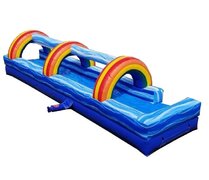
Water features change the energy of a party. In bouncy castle features summer, inflatable slide rentals with water attachments become the main event. Just consider the water source, hose length, and how much your yard can handle. A slide can dump hundreds of gallons into the same square of grass over several hours, turning soil into soup. If drainage is poor, a dry combo may actually be the smarter move.
Safety First, and What That Actually Means On Site
Good operators do more than drop and go. They check placement, stake or ballast properly, and run through rules. In my experience, the best crews carry a mallet, heavy-duty stakes or sandbags for concrete, a measuring tape for setbacks, and a level eye for slope. You want stakes that are 18 inches or longer for grass, hammered fully, with straps snug and not cutting into vinyl seams. On pavement, look for at least four 50-pound sandbags on a small unit or more for larger ones.
Ask about wind policy. Most reputable companies follow a 15 to 20 mph sustained wind cutoff. Gusts matter as much as sustained speeds. Don’t take chances. If the provider cancels for weather, a rain check is standard. If they don’t have a weather policy written down, keep looking.
Power should be simple, but it’s where many parties go sideways. A standard blower pulls roughly 7 to 12 amps. Big pieces with two blowers can draw up to 20 to 24 amps combined. Long extension cords add resistance. You need dedicated 20-amp circuits near the setup or a generator rated for the total amperage with headroom. Good companies bring outdoor-rated, heavy-gauge cords and avoid chaining thin, household lines.
Finally, supervision matters. Most rental agreements say an adult must monitor use at all times. That’s not fine print for the lawyers. It keeps you from piling twelve kids into a unit rated for eight, mixing ages unsafely, or letting flips on a shallow slide. If you have a large event, consider paying for a staffed attendant. It’s often 25 to 45 dollars per hour, money well spent when you’d rather host than police.
Understanding Materials, Sizes, and Space
Not all vinyl is equal. Commercial inflatables use thick PVC or a PVC blend with reinforcements on high-stress points. Consumer-grade bounce houses sold online are lighter and not intended for rental abuse. Most reputable party inflatables companies rotate inventory, patch promptly, and deep clean after each rental. When you see foggy windows, scuffed landings, or seams fraying, ask how old the unit is and when it was last serviced.
Space requirements surprise many first-timers. The footprint listed on a website is the inflated size, not the clearance required. Add three feet on all sides for safe staking and access, more at the entrance and exit. For ceiling height indoors, measure the tallest point, not the arch height listed. Even a compact unit can brush rafters if you misread dimensions. Gates and pathways can be bottlenecks too. A rolled inflatable can be 4 to 6 feet long and 2 to 3 feet thick, weighing 200 to 450 pounds. If your side yard is narrow, flag it early so the crew brings a dolly and extra hands.
Surface preparation goes a long way. Pick a flat spot away from low branches and sprinklers. Mow the inflatable rentals day before, not the morning of, to avoid clippings sticking to vinyl. Mark any shallow irrigation lines if you’re concerned about stakes. Dogs and inflatables don’t mix. Clean the yard and plan to keep pets inside during setup and the event.
How to Compare Quotes Without Getting Burned
Quotes vary because companies package differently. Some include delivery, setup, takedown, and a full-day rental. Others set a 4 or 6-hour window, with hourly add-ons. Cleaning fees, generators, and attendants are usually separate. Ask for an all-in number that itemizes:
- Rental window start and end, delivery and pickup buffer, and any overtime charges Delivery fee by zone, setup on grass versus pavement, and any access surcharges
Check the cancellation policy. A fair policy allows rain checks or date changes with reasonable notice, and weather cancellations without penalty when wind or lightning is a factor. Read the damage liability section. You shouldn’t be on the hook for normal wear, but punctures from sharp objects, silly string, or face paints can trigger fees. Silly string, in particular, melts into vinyl and can cause permanent damage. Good companies warn you ahead of time to avoid it.
Look for insurance. Any company renting to the public should carry at least a basic liability policy. If you’re booking for a school, park, or HOA event, you may need a certificate of insurance with the venue named as additional insured. That’s standard in the industry. The company should be able to provide it within a day or two.
The Budget Spectrum, From Frugal to Festival
If you’re keeping it simple, a backyard birthday for 15 to 20 kids can run under 250 dollars with a basic unit. Pair it with a DIY snack table and a speaker, and you’ve hit 3 hours of happy chaos without breaking the bank. Step up to a combo bounce house rental with a slide for mixed ages, and you’re in the 250 to 350 range. Expect another 75 to 150 if you add a small concession machine like cotton candy or popcorn, which is often included in inflatable party packages.
For bigger events, scale the pieces to throughput. A 30-foot obstacle course keeps lines moving better than a tall single-lane slide. For school field days, I like a mix: one obstacle course, one large dry slide, and one or two standard jump house rentals for the younger grades. That array handles 100 to 300 kids in rotations. Budget 1,000 to 2,500 depending on your market and staffing needs.
If water is in the plan, remember the extra footprint and the post-party lawn rehab. Lay tarps or mats at high-traffic exits to avoid creating a mud pit. Plan towels and a change area. Water slides demand more supervision because kids get fast, and fast means potential pileups. Dry slides are gentler on logistics but don’t beat the heat. Pick based on weather, not just the wow factor.
Seasonal Timing, Lead Times, and Weather Realities
Spring weekends fill quickly once the forecast turns mild. If you need a specific theme or size, reserve 3 to 5 weeks ahead. For peak summer and holiday weekends, book as soon as you settle the date. Weekdays are quieter, often cheaper, and great for camps or neighborhood get-togethers. Some companies offer multi-day discounts if they can drop Friday and pick up Monday, especially during off-peak.
Rain doesn’t always cancel. Many inflatables can run in light drizzle if winds are low, though it becomes a judgment call about fun versus sogginess. Lightning or high winds should shut everything down. A responsible company will call it early enough to adjust plans, and many will let you reschedule within a certain window without penalty. If you’re working with a public park, check their power access and permit rules. Permits often require the operator to be an approved vendor and to show insurance.
Themes, Extras, and When They Actually Matter
Themes are fun, but don’t get stuck chasing the perfect licensed character if it blows your budget. A bright, clean unit with a generic castle or carnival look photographs beautifully and keeps the focus on play. If you’re set on a theme, ask about banners. Some companies use interchangeable banner panels that attach to a standard unit, which costs less than a fully themed piece.
Add-ons can be value or fluff. Concessions create busy hands and happy faces but require an adult who’s okay with sugar clouds and cleanup. Foam machines are a smash hit for older kids and teens, but they need ground prep, power, and water. Dunk tanks look great on flyers, and they’re surprisingly good fundraisers at school events, though they’re less kid-friendly for a preschool crowd.
Cleaning, Sanitization, and Health Concerns
After 2020, cleaning protocols improved, and they should have stayed that way. Operators should disinfect between rentals and arrive with a clean unit. You’ll smell the cleaner but shouldn’t see residue or mildew. If they’re rushing and the unit is damp inside, ask for a quick wipe-down before kids enter. It takes 5 minutes and prevents slips. I’ve turned away a unit once because it arrived visibly dirty after a muddy event. A pro company won’t argue about that. They’ll swap or reschedule.
Shoes off, food out, and face paint carefully managed. Oil-based paints bleed and stain. Temporary tattoos sometimes transfer. Glitter sticks to everything. Clear the area of sticks, rocks, and party favors before kids pile in. A tiny plastic ring can become a puncture if stepped on a dozen times.
Real-World Scenarios and How to Solve Them
You booked a combo for 2 to 6 pm, and the truck hits traffic. A reliable company builds buffers into routes, but your plan B should be flexible. Shift cake or crafts forward, and set a hard stop for pickup so you’re not paying overtime. If you’re at a public park, check whether their curfew includes teardown time. Park rangers tend to enforce those.
Your lawn slopes slightly. Most small inflatables tolerate a gentle slope, but slides require nearly level ground. The crew can rotate the unit or add pads to level minor slopes. For anything more than a few degrees, consider a different spot or a different unit.
You need power across a long yard. Avoid running multiple thin extension cords. Ask the company to bring heavy-gauge cords or a generator. Generators add 75 to 150 dollars in many markets and are worth it when the nearest outlet is 150 feet away or when you’re unsure about the home’s electrical load.
Communication Wins the Day
Texting and email confirmations help, but a call the week of the event is still gold. Confirm gate width, surface type, power availability, and delivery window. Share a photo of the setup area. Note any quirks like sprinklers on timers or a low-hanging cable line. If your event is in a driveway, warn your neighbors so there’s room for the truck to back in. These small touches prevent last-minute pivots.
During the event, appoint one adult as the “inflatable captain.” They don’t have to stand guard the entire time, but they know the rules and stay nearby during peak play. Rotate kids by size if space gets tight. Shut down the unit for a few minutes if excitement spikes into chaos. A reset often restores order better than repeated shouts.
The Case for Packages and Partnerships
If you’re hosting several events a year, build a relationship with a trusted company. Repeat business has benefits: priority scheduling, better package pricing, and faster problem-solving. Inflatable party packages that bundle a bounce house, a concession, and yard games can be smart if you actually need each item. For corporate or community events, ask about half-day and full-day rates, multiple-unit discounts, and whether they provide attendants. A staffed setup reduces your volunteer load and keeps the flow smooth.
For fundraisers, pick inflatables that convert attention into throughput. Obstacle course inflatables handle lines and allow timed races. Sell wristbands or tickets and set clear time slots. A single slide looks impressive but moves people slower, which can bottleneck revenue.
A Simple, Field-Tested Booking Checklist
- Measure the setup space, including gate and path clearance, and note power sources and surface type Match the inflatable to age range, headcount, and weather, then confirm total amperage and whether a generator is required
These steps catch 90 percent of the preventable headaches. Most mishaps I’ve seen trace back to one missed detail: not enough power, a slope that looked minor but wasn’t, a water slide on a yard with poor drainage, or a delivery window that overlapped with a nap schedule. A 5-minute call and a tape measure fix these before they become fixes at the door.
Final Thoughts From the Field
The best jump house rentals make everything else easier. Kids cycle through, burn energy, and go home tired and happy. Parents chat. Photos look great. Cleanup is minimal. The sweet spot is choosing a unit that fits your space, your crowd, and your power, booked with a company that treats safety like a habit, not a sales pitch. If your budget is tight, focus on a clean, basic inflatable and great supervision rather than chasing extras. If you have room to splurge, upgrade to a combo or add an obstacle course, and consider a staffed attendant so you can enjoy the party you worked to plan.
When you search for inflatable rentals, think beyond the first pretty picture. Ask about wind policies, power needs, insurance, and delivery zones. Share photos of your yard. Check reviews for punctuality and cleanliness, not just fun factor. With the right prep, the bounce house becomes the simplest piece of your day, even for a big event.
You only need to get a few decisions right: select the right structure for your guests, book early enough to secure it, and partner with a company that shows up ready. Do that, and your backyard bounce house or full-blown lineup of birthday party inflatables will feel less like a risk and more like a guaranteed good time.